 Aleph Front
Your customers’ procurement teams are investing in AI agents. A new McKinsey article, Agentic AI in strategic sourcing: Hype or hero?, asks whether it is worth it. Its answer: yes, when agents are pointed at the right decisions. The article is written for procurement leaders. If you sell to them, it is worth reading from the other side of the table.
What McKinsey found
In June 2026, McKinsey surveyed chief procurement officers and senior procurement leaders about their plans for AI. The money is flowing, but very little of it has reached scale.
The authors do not conclude that the potential is overhyped. Many leaders deploy agents on individual tasks, which leave today’s workflows largely unchanged. The larger prize lies in sourcing decisions, because they act on external spend, typically 30 to 60 percent of operating expenses. Here is how the figures line up.
McKinsey, October 2026
Everyone is investing. Almost no one is at scale.
| The intent | 80% | plan to increase procurement technology and AI investment within 12 to 18 months |
|---|---|---|
| The reality | 55% | remain in pilot mode |
| 2% | report AI embedded at scale | |
| The prize | 3 to 6% | savings on external spend when agentic AI is deployed correctly |
| 11× | more value from improving sourcing decisions than from automating the procurement function |
You are on the other end of the agent
McKinsey describes a tier-one automotive supplier that applied agents to $150 million of fragmented tail spend across more than 1,000 suppliers. The agents set supplier-specific targets and conducted tailored negotiations, and delivered more than $5 million in savings in under six weeks.
The buy side is moving first. In Deloitte’s 2026 research, based on surveys of more than 1,000 US suppliers and buyers, nearly 40 percent of B2B buyers already use agentic AI in purchasing, against 24 percent of suppliers in the sales process. And the direction is clear: Gartner predicts that by 2028, 90 percent of B2B buying will be intermediated by AI agents, pushing more than $15 trillion of spend through agent exchanges.
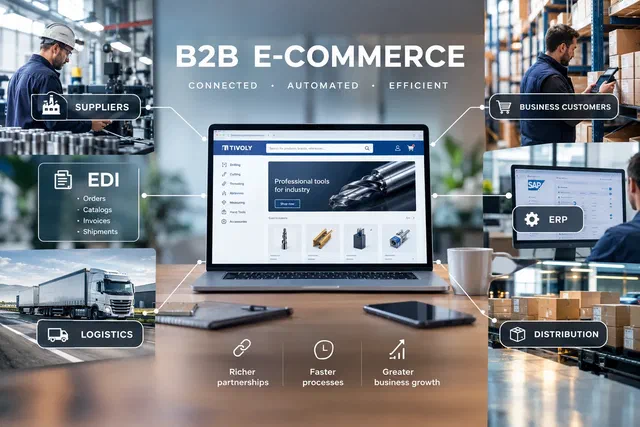
Suppliers sat on the other end of those negotiations. As agents move from automating tasks to improving decisions, the question for a manufacturer or a distributor changes. It is no longer only whether your catalogue is online. It is whether your systems can carry out what the other side has decided.
No order, no value
This part is our view, from the commerce side. An agent’s decision is only as useful as the system that executes it. A negotiated price that cannot be applied, or an approved order that has to be retyped into a supplier’s system, breaks the chain, and the savings stay on a slide.
The order is where a decision becomes real: the right price for that buyer, the buyer’s rules respected, a message your ERP can act on, and a trace of what happened.
What it takes to execute
We built ANOM, our back-office for Intershop, around that chain.
- One price per buyer. ANOM resolves the price for each buyer, with explicit rules for which negotiated price applies.
- Rules before the order. Buyer-side approval workflows and cost centres apply before an order is accepted.
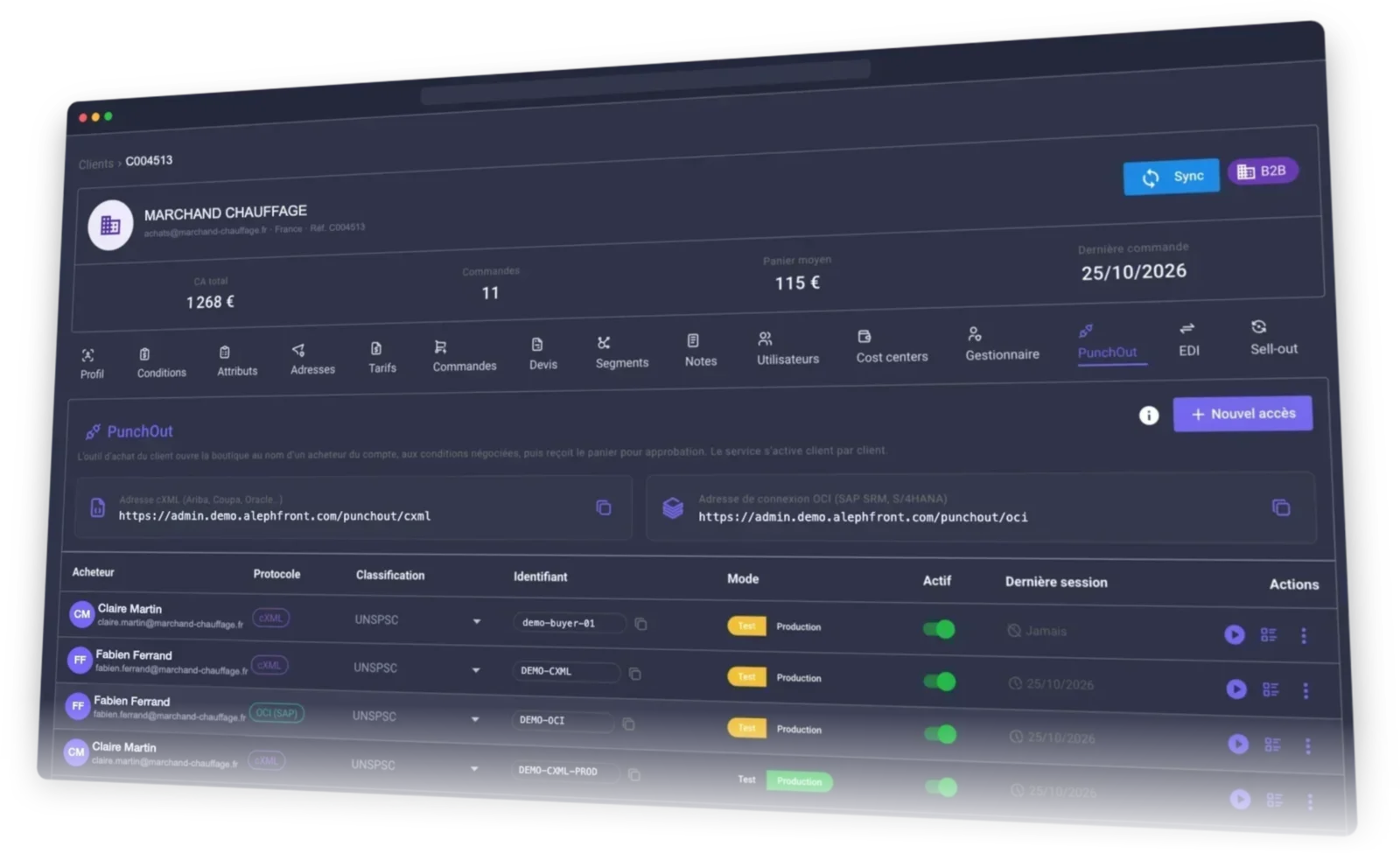
- PunchOut. Over cXML and OCI, with suites such as SAP Ariba and Coupa, a buyer opens your catalogue inside their own procurement system, and the approved cart returns as a requisition.
- EDI. Purchase orders and order responses move between trading partners without manual re-entry.
- MCP. ANOM includes MCP connectors natively, the standard way for AI agents to connect to business systems.
- Intershop untouched. ANOM drives Intershop through its API, so the Intershop core is not modified.
These systems also have to keep up. On the platforms we run, product search answers in under 10 milliseconds per query, and an Infor M3 price lookup went from 535 ms to 0.15 ms.
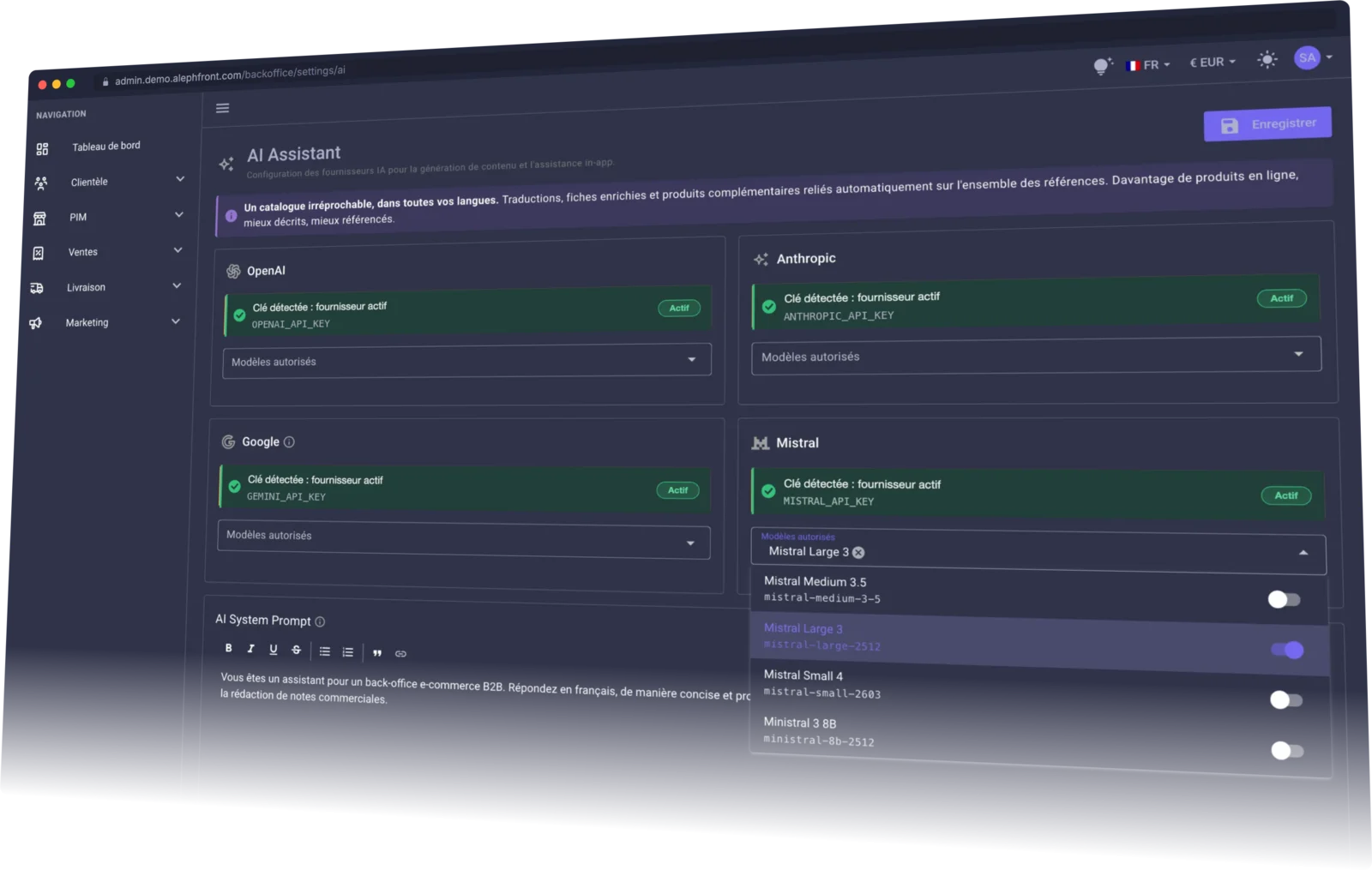
AI is built into the back-office too. It writes product descriptions from technical attributes and fills in missing translations, and an assistant on every page drafts promotions and sales notes. You choose the provider and the models, and your team reviews the content before it is published.
Three questions to ask about your own platform
- Can a buyer’s system get the right price without a person? If a negotiated price lives in a spreadsheet or an email, no agent on the other side can rely on it.
- Are the buyer’s rules enforced before the order is accepted? Approvals, cost centres and limits have to hold, whoever or whatever fills the cart.
- Can an order reach your ERP without being retyped, and can you trace it? That is the difference between a decision and a delivery.
The hype is real, and so is the prize. But a sourcing agent only becomes a hero when its decision has a reliable path to the order. If that path is on your roadmap, we would be glad to show you ANOM on a demo tenant.
Further reading
- Luca D’Avino, Mauro Erriquez and Pradhuman Aggarwal, Agentic AI in strategic sourcing: Hype or hero?, McKinsey & Company, 28 October 2026.
- Agentic commerce: The future of B2B commerce, Deloitte, 26 June 2026.
- Gartner Unveils Top Predictions for IT Organizations and Users in 2026 and Beyond, Gartner, 21 October 2025.